Suboxone is one of the most widely used treatments for opioid addiction, helping many people achieve stability and reclaim their lives. But a question that comes up regularly, both for patients considering treatment and for those already taking it, is whether Suboxone itself carries a risk of addiction[1].
The honest answer is: yes, it can be, but the full picture is more nuanced than that. Used correctly and under proper medical supervision, Suboxone is a safe and effective treatment tool. The risks tend to arise when it is misused or taken without a prescription. This article explores why that distinction matters and what it means in practice.
What is Suboxone?
Suboxone is a prescription medication used in medication-assisted treatment (MAT) for opioid use disorder. It contains two active ingredients:
- Buprenorphine — a partial opioid agonist that eases cravings and withdrawal symptoms[2].
- Naloxone — an opioid antagonist included to deter misuse by blocking opioid effects if the medication is injected.
Together, these ingredients make Suboxone effective at supporting stability in recovery while reducing the potential for abuse.
Can Suboxone be addictive?
Because buprenorphine is an opioid, Suboxone does carry a potential for dependence. However, it behaves quite differently from full opioids such as heroin or oxycodone. Its partial agonist mechanism means it activates opioid receptors less intensely, produces a much weaker euphoric effect, and has a ceiling effect, meaning that beyond a certain dose, increasing the amount does not increase the effect. This also significantly lowers the risk of overdose compared to full opioids.
It’s also important to distinguish between physical dependence and addiction. Dependence, where the body adapts to a medication and requires it to function normally, is an expected outcome of many medical treatments, including Suboxone. Addiction, by contrast, involves compulsive use despite harmful consequences. Many people taking Suboxone as prescribed become physically dependent on it without ever crossing into addiction.
Why does the risk exist?
Even though Suboxone is designed to reduce dependency on opioids, several factors can increase the risk of problematic use:
- Opioid receptor activation: Buprenorphine binds to the same brain receptors as other opioids and still activates reward pathways, albeit more mildly. This means some potential for misuse remains.
- Misuse: Taking higher doses than prescribed, using Suboxone without a prescription, or combining it with other substances can significantly elevate addiction risk.
- Psychological dependence: Some people develop a psychological reliance on Suboxone, feeling unable to cope without it even when it may no longer be medically necessary.
- Unsupervised long-term use: Without regular medical oversight, prolonged use can lead to increased tolerance and dependence that goes unaddressed.
Signs that Suboxone may be being misused
Knowing the difference between therapeutic use and problematic use is important. Possible signs of misuse include:
- Taking more than the prescribed dose
- Seeking additional supplies outside of a legitimate prescription
- Using Suboxone to achieve a high rather than for its intended purpose
- Continuing use despite negative consequences
- Difficulty stopping even when medically advised to do so
- Strong cravings between doses
If any of these signs are present, it is worth speaking to a healthcare professional promptly.
Is Suboxone more addictive than hydrocodone?
Generally, no. Hydrocodone is a full opioid agonist that produces strong euphoric effects, carries a high risk of abuse, and can lead to rapid physical dependence. Suboxone’s partial agonist mechanism, ceiling effect, and built-in naloxone component make it considerably less prone to misuse. When used as directed, Suboxone is widely regarded as the safer option. That said, “safer” does not mean risk-free, and all use should still take place under medical supervision.
Can you get high on Suboxone?
Suboxone is specifically designed to make this difficult. The ceiling effect limits the intensity of any euphoric response, and the presence of naloxone actively blocks opioid effects if the medication is injected. While some misuse does occur — particularly at high doses or in combination with other substances — the potential for achieving a significant high is far lower than with full opioids, and the associated risks remain.
Suboxone withdrawal
Stopping Suboxone abruptly after a period of use can result in withdrawal symptoms, which may include anxiety, irritability, muscle aches, insomnia, nausea, and sweating. While generally less severe than withdrawal from stronger opioids, Suboxone withdrawal tends to last longer due to the drug’s extended half-life.
This is why gradual tapering under medical supervision is strongly recommended rather than stopping suddenly.
Is Suboxone just replacing one addiction with another?
This is a common concern, but it reflects a misunderstanding of how medication-assisted treatment works. While Suboxone does contain an opioid, its purpose and effects are fundamentally different from addictive opioid use. It stabilises brain chemistry rather than disrupting it, reduces compulsive drug-seeking behaviour, allows people to function normally in daily life, and substantially lowers the risk of overdose. Physical dependence on a prescribed medication is not the same as addiction, and for many people Suboxone provides the stable foundation needed to engage meaningfully with therapy and long-term recovery.
How to reduce the risk of Suboxone misuse
For those taking Suboxone, the following steps help minimise the risk of dependence or misuse:
- Take only the prescribed dose, at the prescribed times
- Avoid combining Suboxone with alcohol or other substances
- Attend regular medical appointments and be honest with your doctor about how the medication is affecting you
- Pair medication with therapy or counselling for the best outcomes
- Never stop suddenly — always discuss any changes to your treatment with a healthcare professional first
Treatment if Suboxone is being misused
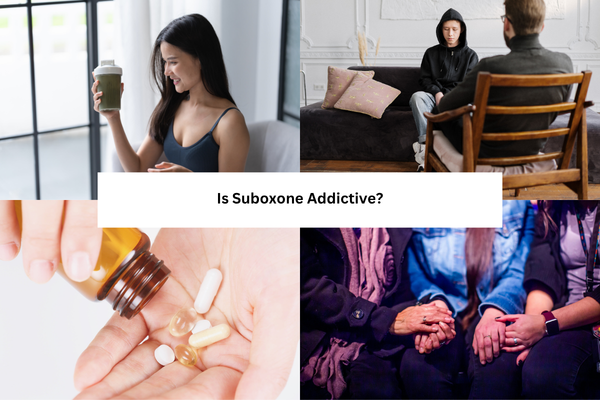
If Suboxone use has become problematic, support is available. Treatment options include:
- Medical detox: A supervised tapering process to safely reduce dependence.
- Behavioral therapy: Counselling to address the underlying drivers of addictive behavior.
- Alternative MAT medications: In some cases, a different medication may be more appropriate.
- Peer support groups: Shared experience and accountability through recovery communities.
Seeking help early, before patterns of misuse become entrenched, makes a significant difference to outcomes.
Final thoughts
Suboxone can be addictive, but that risk needs to be understood in context. When used as prescribed and supported by regular medical oversight, it remains one of the most effective tools available for treating opioid use disorder — and the benefits for most patients clearly outweigh the risks. Understanding how it works, what warning signs to look out for, and how to use it safely puts patients in the best position to get the most from their treatment. If you have concerns about Suboxone or are considering starting treatment, talking to a doctor is always the right first step.
References
| ↑1 | Sivils, A. et al. (2022). “Suboxone: history, controversy, and open questions.” Frontiers in Psychiatry, 13, 1046648. |
|---|---|
| ↑2 | Sadée, W., Rosenbaum, J.S. and Herz, A. (1982). “Buprenorphine: differential interaction with opiate receptor subtypes in vivo.” The Journal of Pharmacology and Experimental Therapeutics, 223(1), 157–162. |